Cashmere vs Merino Wool for Kids' Sweaters
Both fibers get called the softest thing you can put on a child, and both cost more than a basic knit. The real differences show up after the third wash and the tenth school day, which is where this comparison lives.
We make knitwear for kids ages 2 through 13, including the cotton-cashmere knits this question often leads to, so we’ve spent years working with cashmere blends. Here's how they compare when the person wearing the sweater is seven.
Cashmere vs Merino: The Key Differences
Cashmere is softer and warmer for its weight. Merino is stronger, more breathable, easier to wash, and less expensive. For a child who wears a sweater to school, plays hard in it, and drops it in the regular hamper, merino wins on practicality while cashmere wins on feel and still-air warmth.
The quick rundown:
-
Fiber source: the combed undercoat of cashmere goats vs. the shorn fleece of Merino sheep
-
Fineness: cashmere runs about 14–19 microns; high-grade merino about 17–22
-
Warmth for weight: cashmere, on loft and crimp
-
Breathability and moisture management: merino
-
Durability and pilling resistance: merino
-
Washing: many merino garments take a gentle machine cycle; cashmere wants a hand wash
-
Price: merino sits well below cashmere at comparable quality
There's no universal winner between these two natural fibers. What decides it is how your child wears the sweater: where it goes, what rubs against it, and what happens to it on laundry day.

What Each Fiber Actually Is
Cashmere comes from the downy undercoat of cashmere goats, combed out during the spring molt rather than shorn. A single goat yields roughly 150 grams of usable down per year, so it takes about four goats to make one sweater, while one Merino sheep supplies enough fleece for several. That math explains most of the price gap.
Merino comes from Merino sheep, a breed developed over centuries for unusually fine wool and shorn once a year. "Merino" names a fineness grade rather than a single quality tier: an 18.5-micron merino sweater feels different against the skin than a 23-micron one.
Micron count measures fiber diameter, and it matters because it predicts itch. Skin registers prickle when fibers are stiff enough to poke instead of bend, which happens at roughly 30 microns. A human hair is about that wide.
Cashmere at 14–19 microns and fine merino at 17–22 both sit comfortably under that line. That's why neither feels like a scratchy old wool blanket, and why standard sheep's wool does.
Both are staple fibers, and both are graded. Long-staple cashmere resists pilling far better than short-staple, so two 100% cashmere sweaters at very different prices are usually different products rather than different markups.

Warmth, Weight, and Temperature Range
You'll see the claim that cashmere is seven to eight times warmer than sheep's wool. That figure circulates through the industry without a verifiable source, and even where brands repeat it, it describes warmth per gram against ordinary sheep's wool. It was never a claim that a cashmere sweater outwarms a merino one of equal weight.
Here's what holds up: cashmere fibers are fine and crimped, and they trap an unusual amount of air relative to their weight. That loft is cashmere's real advantage. A lightweight cashmere knit holds heat that a same-weight cotton or standard-wool knit can't.
Merino's advantage is regulation rather than raw insulation. The fiber absorbs around a third of its weight in moisture vapor before it feels wet, wicking dampness off the skin and continuing to insulate when a kid sweats. It performs across a much wider band of temperature and activity.
For a child, that difference is concrete. On a school day, a kid moves from a cold walk to a heated classroom to recess and back. Merino handles those swings without going clammy; cashmere runs warm at the desk by mid-morning.
On a snow day spent mostly outside, either fiber works under a coat, though merino recovers better if the kid gets sweaty sledding. Cashmere shines as a mid-layer under a shell: the most warmth for the least bulk, for the kid who refuses puffy layers.
On a travel or holiday day, mostly indoors or buckled into a car seat, cashmere's still-air warmth is at its best. That's the day pure cashmere was made for.
One caveat at the margins: gauge and knit density can matter more than fiber. A chunky merino knit outwarms a featherweight cashmere one. Check the fabric's weight, and don't rely on the fiber name alone.
Softness, Itch, and Sensitive Skin
The question parents are really asking is whether the kid will refuse to wear it. Micron count is the biggest predictor of softness, but fiber length, surface finish, and how the yarn was spun all shape prickle too.
That's why merino sometimes still itches a very sensitive child despite its low micron count. Wool fibers carry surface scales, and finishing treatments like superwash alter them differently from garment to garment. Spinning quality can matter as much as the number on the spec sheet.
Two facts help sort out reactions. True wool allergy is rare; most reactions are mechanical irritation, and lanolin contact allergy is unlikely with modern garments. And merino contains lanolin while cashmere carries none, so cashmere is often the easier fiber for a child with a known lanolin sensitivity.
Both fibers soften with wear and washing. Cashmere's shorter staple gives it the softer first touch, though the same short fibers can shed a fuzzy halo at the collar early on. That settles after a few wears.

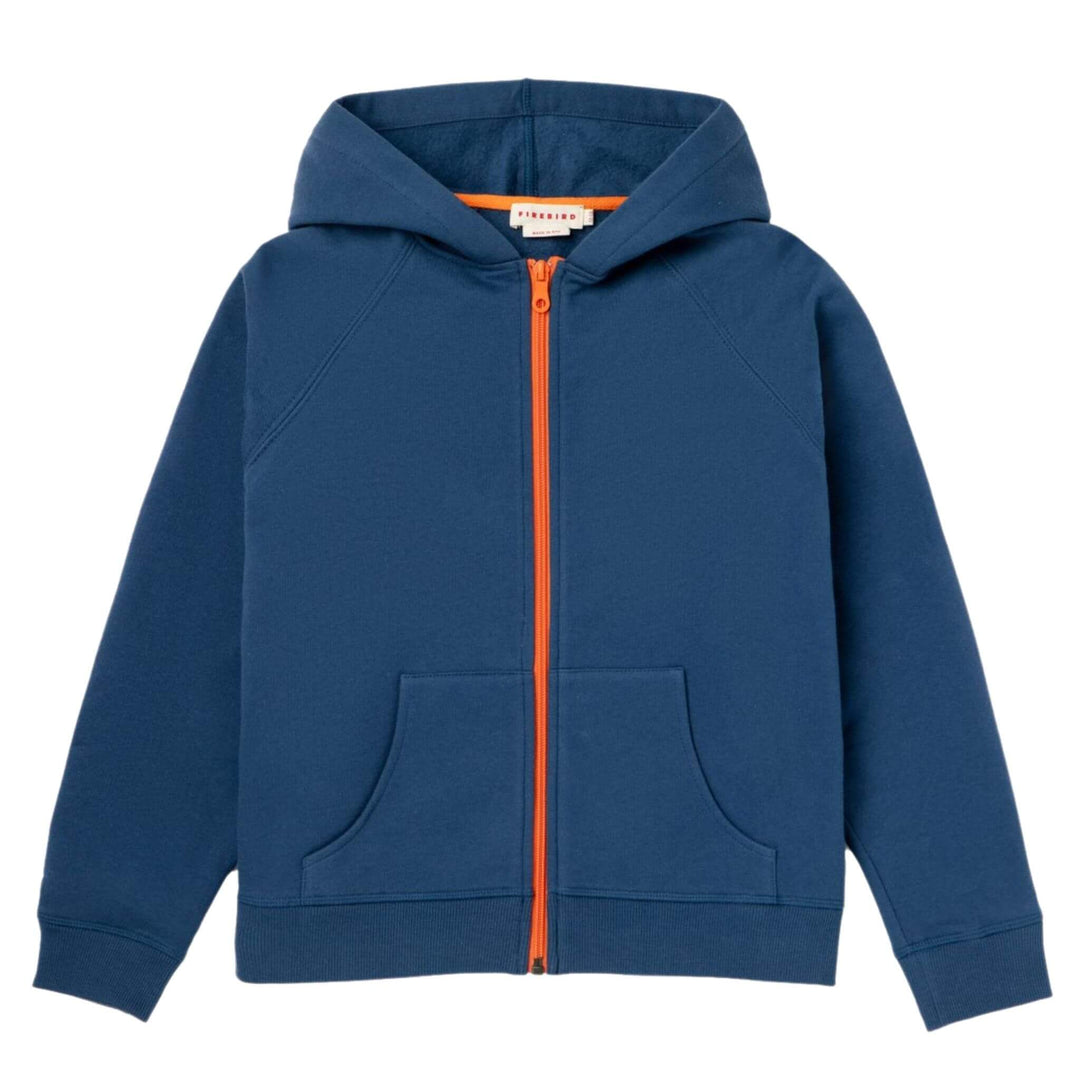
There are structural answers to the itch problem too. A fine merino base layer keeps coarser knits off the skin, and some sweaters add a cotton-lined collar. Our answer is the cotton-cashmere hoodie sweater: 85% Egyptian Giza cotton carries the fabric, 15% cashmere carries the hand feel, and the animal-fiber contact issue largely disappears.
For a fuller look at fiber choices for eczema-prone kids, our guide to the best fabrics for sensitive skin goes deeper.
Durability and Pilling on Kids' Clothes
A kid's sweater wears in different places than an adult's. The friction points are backpack straps, the seatbelt line, the underarms, and the forearms that live on a desk edge. That wear map is harsher than anything a commuter's sweater faces.
Merino is the more durable fiber. It has higher tensile strength, more natural elasticity, and better recovery, so it springs back where cashmere gradually relaxes. It also resists pilling better.
Cashmere pills, especially in those high-friction zones, and it helps to know which kind of pilling you're looking at. Early fuzz is loose short fibers working their way out of the yarn: normal, finite, and it de-pills cleanly with a comb. Pilling that keeps returning month after month signals short-staple fiber breaking down, and no comb fixes that.
Our post on keeping kids' sweaters from pilling covers the technique side, comb and all.
Blends deserve a direct word here. In a child's wardrobe, a cotton-cashmere or cotton-merino blend usually outlasts either pure fiber, because the stronger fiber carries the structure at the stress points. The trade is real: you give up some warmth per gram and a little of the pure-fiber hand.
A well-made sweater in either fiber should clear two or three seasons on one kid, then hand down or resell in honest condition. Merino gets there with less maintenance. Cashmere gets there only if the care holds up.

Washing and Everyday Care
For most families this is the deciding difference. Cashmere wants a cold hand wash with wool detergent, or a delicate wool cycle at most, then a flat dry. Dry cleaning works but isn't required.
The rules stop feeling arbitrary once you know the mechanism. Wool-family fibers carry microscopic surface scales, and heat plus agitation locks those scales together. That's felting: the fabric shrinks, stiffens, and can't be undone.
Merino is more forgiving. Many merino garments take a gentle cold machine cycle, especially superwash-treated ones. Superwash smooths or coats the fiber's scales so they can't lock, which is what makes machine washing safe. It also changes the fiber: superwash merino feels slicker, and the polymer coating complicates the pure-natural-fiber story for families avoiding synthetics.
Then there's the honest household question: how many hand-wash garments will your house maintain in February? A hand-wash-only sweater in a home with one laundry routine usually ends up shrunk or unworn, and neither outcome justifies its price.
We built around that constraint. Our cotton-cashmere hoodie sweaters are made for a cold machine wash with mild detergent, which is where we think cashmere realistically fits a kid's rotation: as a blend the washer can handle.
If you do go pure fiber, the routines are short:
-
Cashmere: cold hand wash with wool detergent, press water out in a towel, dry flat, comb off early fuzz, store folded with cedar over summer.
-
Merino: cold gentle cycle in a mesh bag if the tag allows, lay flat to dry, never the dryer, same cedar storage against moths.
Cost, Value, and Cost Per Wear
Merino costs less than cashmere at comparable quality, and cotton-cashmere blends sit between the two. The gap is structural: yield per animal, hand-combing labor during a short spring harvest, spinning quality, and country of manufacture.
Cost per wear is the honest metric for children's knitwear, and it works differently than it does for adults. A kid usually outgrows a sweater before wearing it out, so the fiber's durability ceiling matters less than its condition at handoff. A sweater that still looks right passes to a sibling or lists well on resale, and that recovered value is part of the real price. It's why we run Pass It On, our resale program.
What separates two 100% cashmere sweaters at the same fiber percentage is mostly invisible on the tag: staple length, ply, gauge, and finishing. Two-ply yarn at a tight gauge from long-staple fiber costs more to knit and lasts years longer.
The low-price trap runs in both directions. 100% cashmere at a fast-fashion price is almost always short-staple and pills out within a season. A cheap "wool blend" is often mostly acrylic with a token wool percentage.
Knitwear is also its own manufacturing discipline, slow and craft-heavy, which is why very few kids' brands make it at all. Ours is knit in small batches in New York City; we filmed a visit to our knitwear factory in NYC if you want to see what that knitting-and-finishing quality looks like in person.
Reading the Label: Blends and Percentages
"Cashmere blend" on a tag can legally mean a small percentage, so the number matters more than the word. At 5% cashmere you're paying for the label; at 15% the hand feel changes noticeably; at 30% the warmth starts to change too.
Common kids' blends each have a logic: cotton-cashmere for softness with washability, merino-nylon for durability at the wear points, wool-acrylic for price, cashmere-silk for drape.
A few tag details signal quality without announcing it: two-ply yarn, Grade A or long-staple cashmere, a stated micron count, Woolmark, OEKO-TEX, and GOTS certification on the cotton portion of a blend.
Origin markers like Italian-spun yarn or Inner Mongolian cashmere point to established supply chains. They raise the odds of quality without guaranteeing any specific garment, so read them alongside the ply and staple details rather than instead of them.
Choosing by How Your Child Wears It
Match the fiber to the week your child actually has. Across our kids sweaters, the pieces that live in heavy rotation are the ones whose care fits the household.
-
Everyday school rotation: merino or a cotton blend; it takes the washing.
-
Outdoor, active cold weather: merino; it insulates when damp and recovers its shape.
-
Holidays, photos, travel: cashmere; the best warmth and drape for low-output days.
-
Next-to-skin base layers: fine merino, ideally 18.5 microns or under.
-
Sensitive skin or lanolin issues: cashmere, or a cotton-cashmere blend that limits skin contact further.
-
Mild climates and overheated classrooms: often neither; a heavy cotton sweater or fleece is the better tool.
-
Pieces meant to hand down: a blend, where the stronger fiber holds the shape kid after kid.
Age changes the math. A toddler outgrows a size in months and puts everything through constant washing, so a cotton-cashmere hoodie sweater makes the most sense: it survives the wash cycle and still cascades down to the next child. Older kids hold sizes longer, and from around eight they have opinions: a sweater they call itchy stays in the drawer no matter what it cost.
Our girls sweaters run the same spectrum, chunky cotton knits through cotton-cashmere hoodies, so you can match the fiber to how she wears her week rather than the other way around.
The Laundry Routine Decides
If you strip this comparison to one question, it's this: what happens to the sweater on wash day? Merino, especially superwash, survives a normal household routine. Pure cashmere asks for a separate one.
A house that will keep a hand-wash habit through February can own cashmere happily and hand it down in good condition. A house with one hamper and one cycle should choose merino, a heavy cotton knit, or a blend engineered for the machine.
The most predictive factor in whether a cashmere sweater survives a childhood is whether your laundry routine can keep its side of the deal. Choose the fiber your routine can keep, and either one will outlast the size.