Family Christmas Photo Outfits: What to Wear, Kid by Kid
Family Christmas photo outfits get decided earlier and under tighter constraints than most families expect. The light is lower, the backdrop already carries color, and the photos have a second job as a holiday card that prints on a deadline.
This guide covers the color palettes that photograph well, how light should change your choices, and how to dress kids across a wide age spread. We make kids' clothing, so the kid sections here run deepest. Most guides on this topic give the children one line.
What Makes Christmas Photo Outfits Different
Much of a holiday shoot happens indoors or after dark, which fall and spring sessions rarely deal with. The backdrop is often decorated, so the tree, lights, and garland bring their own color into the frame. And the images end up on a card, which adds crop and layout constraints.
The timeline is the part that catches people. Sessions get booked October through early December, and cards print by early December, so outfit decisions land three to six weeks earlier than the shoot date suggests. Our holiday kids' clothes collection is built around that window.

You're choosing between three session formats: outdoor (a Christmas tree farm, snow, a park), styled indoor or studio, and at-home lifestyle. Each pulls the palette in a different direction, and we'll reference all three throughout.
For general foliage-season advice, our fall family photo outfits guide already covers it. This piece handles what changes in December.
Holiday Color Palettes That Actually Photograph Well
The working rule across every good family photo: pick two focal colors, ground them in neutrals, and put no single color on more than two family members. That's what "coordinate, don't match" means in practice. A shared palette reads as a family; identical outfits read as a uniform.
Our kids' sweaters do a lot of the work in every palette below, because most December photos get taken in knits.
A few optical facts drive the choices. Saturated red bounces color onto skin at close range, which is why faces near a bright red sweater pick up a pink cast. Pure white blows out under warm indoor light. Black swallows knit texture in low light, so a black cable-knit photographs as a flat shape.
1) Deep Red and Forest Green, Handled Carefully
Red and green is the classic Christmas palette and the one most likely to look like a costume. The fix is desaturation and material. Choose wine, cranberry, and pine over true red and kelly green, and put those shades in knits rather than shiny fabrics.
Distribute the colors instead of pairing them. One child in a green knit, one adult in wine, everyone else in cream or denim. And skip red entirely at a tree farm or in front of a decorated tree, where red is already in the frame.
2) Cream, Camel, and Oatmeal Neutrals
This is the strongest palette for indoor and at-home sessions, and the one that ages best on a wall. A neutral palette still needs contrast, and texture is where it comes from. This palette depends on cable knit, ribbing, waffle, corduroy, and brushed cotton.
Choose ivory and oatmeal over pure white, for the blowout reason above. This is also the one palette where the same color on several family members still reads as intentional, as long as the textures differ.

Our cotton-cashmere knits were made for exactly this job. The cotton-cashmere hoodie sweater in ivory, sized 4-5T and up, hits the ivory-over-white rule.
Knits are also the piece of this palette worth understanding. A well-made knit takes craft knowledge and time, and a look behind the scenes at our NYC knitwear factory shows why one lasts years.
3) Navy, Denim, and Chambray
The most practical palette, because most of it is already in the closet. Layer different washes for depth, then pair with cream or camel rather than adding a third color.
A soft knit over denim is the reliable kid formula here. The same cotton-cashmere hoodie sweater, this time in soft blue, is that layer, light enough to go under a coat for an outdoor session.
Navy is strong for urban, at-home, and overcast outdoor sessions. It goes muddy in low-light indoor settings, so save it for daylight.
4) Monochrome and Tonal Layering
Build the whole look from one color family instead of a two-color scheme: greens, browns, or grays layered across the group. It reads modern and photographs cleanly against decorated backdrops, because the family stays visually separate from a busy frame.
The requirement is mixed textures and at least two shades apart in value. Sage next to olive next to forest works. Three garments in the same mid-green flatten into one blob.
5) Muted Plaid and Small-Scale Pattern
Pattern is fine. Scale and count are the risks. Put one patterned family member at the center as the anchor, then dress everyone else in solids pulled from that pattern's colors.
Avoid identical prints across the family, large-scale plaid on small kids, high-contrast graphics, and any visible logo. Small-scale gingham, tonal stripes, and dark-ground florals are the low-risk options.
How Light Changes What You Should Wear
Confirm the session's light before you choose the palette. It's the single decision that competing advice skips, and it changes everything below.
Indoor and evening sessions run on warm artificial light plus tree lights, which shift color temperature. Cool blues turn gray, pale fabrics turn amber, and mid-tone or saturated colors hold their character. If your session is in the living room after 4 p.m., that's the physics you're dressing for.
Outdoor winter light works the opposite way. Bare branches and snow act as a giant reflector, raising contrast and flattening pale fabrics. Against snow specifically, everything reads darker, so mid-tones and jewel tones outperform neutrals there.
Golden hour arrives dramatically early in December, often before 4 p.m. For an outdoor session with young kids, that means scheduling around naps and dinner gets tight, and a late start costs you the light entirely.
Overcast is an advantage. Even light, no squinting, no shadow across faces. If the forecast turns gray, keep the session.
Dressing Kids for a Holiday Session
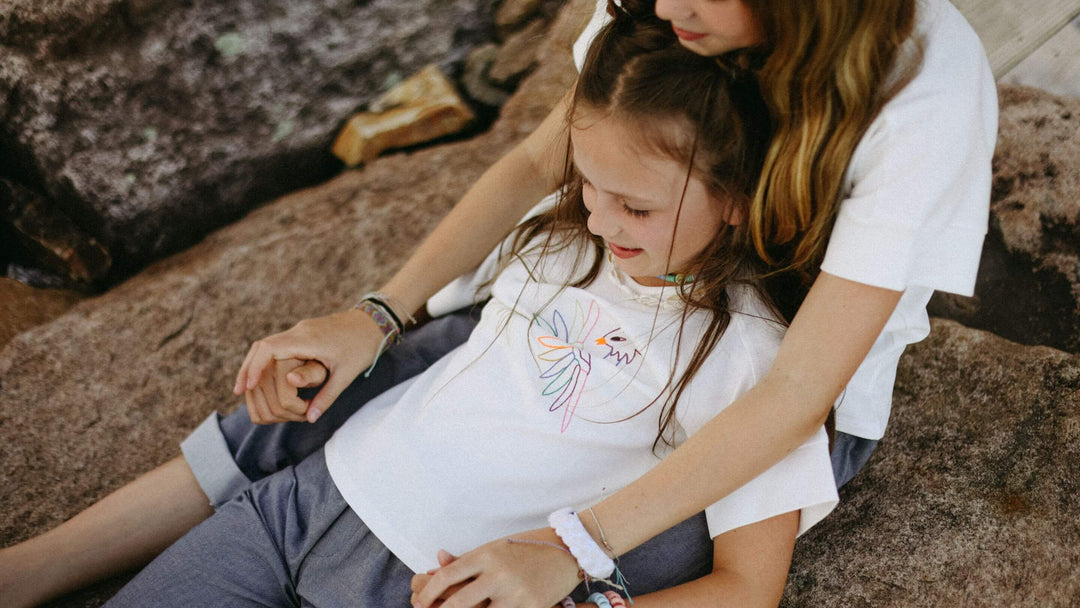
The real tradeoff is photo-formal versus a kid who can still move. Restrictive clothing produces visibly stiff photos, because a kid who can't move stops smiling within minutes. Comfort is a photographic argument here.
Construction decides whether a kid lasts the hour. Look for soft waistbands, no scratchy collars or tags, knits over stiff woven formalwear, and room through the shoulders. A kid tugging at a collar shows up in every frame.
Layers solve two problems at once. Kids who move between indoors and outdoors repeatedly need a temperature strategy, and a cardigan over a tee adds visual depth on camera. Our winter layering guide covers the system.
Footwear is the most-forgotten item. A wet tree farm ruins dress shoes in ten minutes, and a studio floor is unforgiving to slick soles. Boots or clean sneakers that a kid has already worn beat anything new.
Kids' formalwear has a real place: short, styled indoor sessions of 45 minutes or less. Anything outdoors or longer, and it backfires. For that longer range, the knit-and-denim end works harder. The Studio Denim Pant looks sharp in photos and is still very comfortable, with a drawstring waist and no buttons or zippers for a kid who won't sit still.
1) Toddlers and Preschoolers
Mobility, dirt tolerance, and a strict time budget rule this age. One-piece and simple two-piece looks survive being picked up and put down. A backup outfit is standard practice, since one juice box or one puddle shouldn't end the session.
2) Babies in the Frame
Keep it simple and layered, and skip bulky pieces that swallow a small body. One useful trick: put the baby in a slightly more saturated shade of the family palette. The eye goes to the baby without the baby being dressed differently.
3) Siblings Who Coordinate Without Matching
This is the most-asked and least-answered question in the topic: how do you dress a 2-year-old and an 11-year-old in the same photo? The method is the same palette in different garment types and textures. The toddler in a cranberry knit, the older kid in a chambray button-front with a wine cardigan.
What looks cohesive on a 2-3T and a size 12-13 is rarely the same garment, because the proportions differ too much. Identical outfits work in one case: two kids under five. Past that, coordination beats duplication every time.
Adult Outfits That Anchor the Group
Start with the hardest outfit to source, then pull everyone else's colors from it. Usually that's one adult's anchor piece, and the rest of the family dresses from its palette.
The compact formulas: for at-home sessions, a knit and dark jeans for both adults. For outdoor, layered mid-tones with a structured coat. For styled indoor, one adult in a midi dress or slim sweater and skirt, the other in a button-down and chinos. The fall guide covers adult styling in more depth.
Matching Your Outfits to the Setting
One rule applies to every backdrop: never wear its dominant color.
At a Christmas tree farm or evergreen lot, green and red already dominate, so neutrals and blues separate the family from the background. In front of a decorated indoor tree, the frame is warm, busy, and low-light, so simple solids in mid-tones keep the family legible.
Snow and winter fields reflect hard, cool light, so saturated and mid-tone colors read best while pale neutrals wash out. A studio seamless needs deeper color to keep the family from merging into the sweep. Urban settings are neutral concrete and brick, where jewel tones and structured layers stand out.
Christmas Pajama Photos as a Separate Look
Pajama photos are their own format with their own rules. They work for at-home sessions, Christmas-morning shots, and as a second-outfit change. They don't work in a formal studio or outdoors in the cold.
What photographs well in a pajama set: real fit rather than bagginess, enough fabric weight to hold a shape, and a small-scale print or solid over a large novelty graphic. Across a wide age spread, coordinate the sets rather than putting the whole family in one print.
Our kids' pajamas, sized 2-3T through 12-13, cover all three: a snug fit, a substantial organic Pima cotton interlock that holds its shape, and a small crocodile print with blue contrast cuffs. That snug fit is also how they meet CPSC sleepwear safety standards without flame-retardant chemicals, which is worth knowing when kids sleep in what they wore for the photo.
Making the Photos Work as a Holiday Card
Cards impose constraints the session doesn't. Most layouts crop vertical or square and reserve zones for text, and very busy patterns fight the card's typography. Simpler outfits leave room for the card design.
Work the print timing backwards. If cards mail the second week of December, printing happens the first week, which puts the session in November and the outfit orders in October.
Should the shoot palette match the card palette? The honest answer is that it shouldn't conflict. A cream-and-navy family on a gold-and-red card fights itself; the same family on a cream card doesn't. The two palettes only need to avoid clashing.
What to Avoid, and Why
Each of these rules has a mechanism behind it, which is why they hold:
-
Pure white under warm indoor light blows out; black in low light erases texture; neon near faces casts color onto skin.
-
Logos, slogans, and licensed characters pull the eye off faces and date the photo, holiday-novelty versions included.
-
Everyone in the same print reads as a uniform; more than two patterns in one group competes; large-scale pattern overwhelms the smallest kids.
-
Brand-new stiff clothes worn for the first time on session day show it. Kids fidget in unfamiliar fabric.
-
Wearing the backdrop's dominant color merges the family into the frame.
-
Sequins and metallics beyond small accents flare under flash and tree lights, and the reflection lands in the edit.
Getting Everyone Ready on Session Day
Steam or de-wrinkle everything the night before, and run a lint roller over the knits. Knitwear picks up lint and pet hair more than any other fabric, and the camera finds all of it. Our guide to keeping kids' sweaters from pilling covers the care side.
Pack a backup outfit per child and decide in advance where the change happens. Bring snacks, schedule around naps, and build in slack for one meltdown, because the session that plans for a meltdown usually avoids it.
Bring layers even for an indoor session, since studios run cold and living rooms run hot. And ask the photographer one question ahead of time: do the edits run warm-toned or true-color? A warm edit pushes creams toward amber and cools nothing, which changes how your palette lands.
Buying for the Session Versus Building From the Closet
Most of the look already exists in your closets. The real decision is which two or three anchor pieces to order new: the outfit that sets the palette, the piece everyone else's colors pull from, and anything that has to fit precisely on camera.
The tradeoff worth doing math on: a single-use novelty outfit versus a knit or pair of pants that stays in rotation through winter. The novelty piece gets worn for 45 minutes. The knit gets worn through February, then handed down or resold. Cost-per-wear tells you which one was expensive.
Order three to four weeks ahead to leave room for returns and exchanges, and expect kids' sizing at the top of a range to run differently than the middle. A first wear on session day is a risk either way, so wash and wear everything once before the shoot.
We sit on the rotation side of that tradeoff. Our organic cotton knitwear, denim, and pants run 2-3T through 12-13 and photograph well, but they're built for regular wear, which is a different proposition than a holiday-specific outfit.
If you want the photo pieces to keep working afterward, pair a knit that sets the palette with a pant that survives the session. Our Red Striped Crewneck Sweater has gray and ivory stripes quiet enough to make it the one patterned piece in the group, and its red trim brings in holiday color in a small dose. The Studio Denim Pant from earlier carries on through the rest of winter.
The Same Clothes, Three Occasions
The strongest reason to choose well is that the outfits have three jobs, and almost nobody plans for the second and third. The session comes first. Then Christmas morning, where the pajamas and the knits show up again in the candid shots. Then the holiday gatherings, where the same sweater does another month of work.
Choose a palette for the light you'll have, dress the kids for movement, and put the money in the two or three pieces that carry past the card. The photo lasts twenty years on the wall. The clothes should at least last the winter.