The Non-Toxic Kids’ Clothes Guide
“Non-toxic” is on a lot of kids’ clothing labels right now. It rarely means the same thing twice. There’s no single legal standard behind the phrase, so a brand can print it next to real certifications or next to nothing at all, and the tag looks about the same either way.
This guide is about evaluating those claims rather than trusting them. We make GOTS-certified organic cotton kids’ clothes, so we spend a lot of time reading the fine print on materials and finishes. What follows covers the chemicals worth knowing about, how to read a label, which certifications actually verify a claim, and how to tell a transparent brand from a vague one.

What “Non-Toxic” Actually Means
At its most useful, non-toxic means no intentionally added hazardous chemistry: no stain-repellent coatings, no wrinkle-resist resins, no dyes carrying substances you’d rather keep off your kid’s skin. It describes what a garment leaves out.
The catch is that no regulator defines the word for clothing. It isn’t a certified label like organic food carries. That’s why the same phrase can mean careful sourcing on one hangtag and marketing on the next.
So treat “non-toxic” as a claim to check, not a guarantee to accept. The rest of this guide walks through the chemical categories that matter (PFAS, flame retardants, dyes and finishes, and formaldehyde), then the labels and certifications that tell you whether a brand backs the claim up.
The Chemicals Worth Knowing About
You don’t need a chemistry background to shop well. You need to recognize a handful of chemical families, know why they’re used, and know which garments to check first.
PFAS (“Forever Chemicals”)
PFAS are a large group of synthetic chemicals valued for repelling water, oil, and stains. On clothing, they’re what makes a jacket bead rainwater or a pair of pants shrug off spaghetti sauce.
These compounds resist breaking down in the environment and can accumulate in the body over time, which is why researchers studying how PFAS behave in the body have flagged associations with liver, thyroid, immune, and certain cancer-related effects. A peer-reviewed review of the same evidence catalogs those categories of concern. These effects are associated with PFAS exposure and still under active study, not settled cause-and-effect.
In kids’ clothing, PFAS show up where performance is the selling point: rainwear, “stain-resistant” school uniforms and play clothes, and some tags and labels. When a garment promises it repels messes, that’s the first place to ask what’s doing the repelling. A plain untreated cotton pair of kids’ pants skips that chemistry entirely.
Flame Retardants
Parents ask about pajamas more than any other category, and the reason is regulatory. The federal flammability standard for children’s sleepwear requires that garments above nine months and up to size 14 either pass a flame-resistance test or fit snugly against the body.
Untreated 100% cotton usually fails that test. So a cotton pajama set has two honest routes: it can be chemically treated to resist flame, or it can be cut snug and sold untreated with a hangtag telling you to buy the correct close fit. A third category, some synthetics, is inherently flame-resistant without added treatment.
You can tell them apart on the tag. Treated sleepwear says it’s flame-resistant. Untreated snug cotton carries a label noting it is not flame-resistant and should be worn tight-fitting for safety. If you prefer the untreated route, our kids’ pajamas follow the snug-fit approach.
Synthetic Dyes and Finishes
Color and “easy care” are where a lot of quiet chemistry lives. Certain azo dyes can break down into compounds restricted in stricter markets, and the finishes that keep fabric looking new (wrinkle-free resins, anti-shrink treatments) are added chemistry by definition.
The useful signal here is any promise that a garment stays pristine. “Keeps its shape,” “no-iron,” “won’t shrink.” Those are features engineered onto the cloth, and they’re worth a second look when you’re trying to keep chemistry off your kid.
Formaldehyde and Wrinkle-Resistant Treatments
Formaldehyde-based resins are the classic wrinkle-resistant finish, used for permanent-press and anti-shrink effects. Government testing on wrinkle-free clothing and formaldehyde found that no U.S. agency requires labels to disclose it, so the words to watch for are the effects: “wrinkle-free,” “easy-care,” “permanent press.”
The finish off-gasses over time, and washing before first wear reduces the free formaldehyde sitting on the fabric. It won’t remove all of it, since the resin is bonded into the fibers on purpose. Prewashing helps; it isn’t a full detox.

How to Read a Label and Tag
Once you know the chemical families, the tag becomes readable. Three things carry most of the information:
1) Fiber content comes first
A garment that's 100% organic cotton, linen, or wool tells you what it's made of. A blend heavy on polyester, nylon, or elastane is more likely to carry performance finishes. Natural fibers aren't automatically clean, but they start from a simpler place.
2) Care and treatment language is the second signal
Words like "stain-resistant," "wrinkle-free," and "flame-resistant" describe added chemistry, not just laundry instructions. Read them as ingredient labels in disguise.
3) Country of origin is a softer, secondary clue
It doesn't certify anything on its own, but production standards vary, and where a garment is made can hint at what oversight it passed through.
One more thing matters as much as what's printed: what's legally left off. U.S. labels don't have to disclose most finishing chemicals, so the absence of a warning is not the absence of chemistry. A clean-looking tag can still hide treatments the law never required anyone to name.
One more thing matters as much as what’s printed: what’s legally left off. U.S. labels don’t have to disclose most finishing chemicals, so the absence of a warning is not the absence of chemistry. A clean-looking tag can still hide treatments the law never required anyone to name.
Certifications That Verify the Claim
This is what a careful shopper is really searching for. Two certifications do most of the real verification work, and they don’t check the same thing.
GOTS (Global Organic Textile Standard)
GOTS certifies organic fiber plus the processing around it. To carry the mark, a textile has to meet organic sourcing requirements and clear restrictions on the chemicals used in dyeing and finishing, along with some social criteria in production. It’s the stricter of the two because it governs the whole pipeline, not just the finished cloth. Our own materials are GOTS-certified organic cotton for exactly that reason.
OEKO-TEX Standard 100
OEKO-TEX Standard 100 tests the finished product for a long list of harmful substances and certifies it if levels come in under set limits. The difference from GOTS is the scope: OEKO-TEX asks whether the final fabric tests clean, while GOTS asks whether the fiber was grown organically and processed within restrictions the whole way through. A garment can be tested-clean without being organic.
Where Certifications Fall Short
Neither mark is a force field. Certification often covers the main fabric while trims, prints, or dyes fall outside the certified scope, so a “certified” garment can still include uncertified components. And plenty of “eco” or “green” badges have no issuing body at all. If a logo doesn’t name the standard behind it and who audits it, treat it as decoration.
Natural Fibers vs. Performance Fabrics
Here’s the practical trade-off most parents actually face. Natural fibers like organic cotton, wool, and linen breathe well, feel soft, and carry a simpler chemical profile. Performance synthetics resist stains and wrinkles and dry fast, which is convenient, but that convenience is often the finish you’re trying to avoid.
The honest cost of skipping those finishes is real. Untreated cotton can shrink roughly 10 to 15% because it hasn’t been chemically stabilized against it, and it wrinkles more than a resin-treated blend. That shrink is the price of leaving the anti-shrink chemistry out.
Our soft denim pants are one example of the choice: a bottom made without stain or wrinkle performance treatments, which is also why they work for the kids who hate stiff jeans.
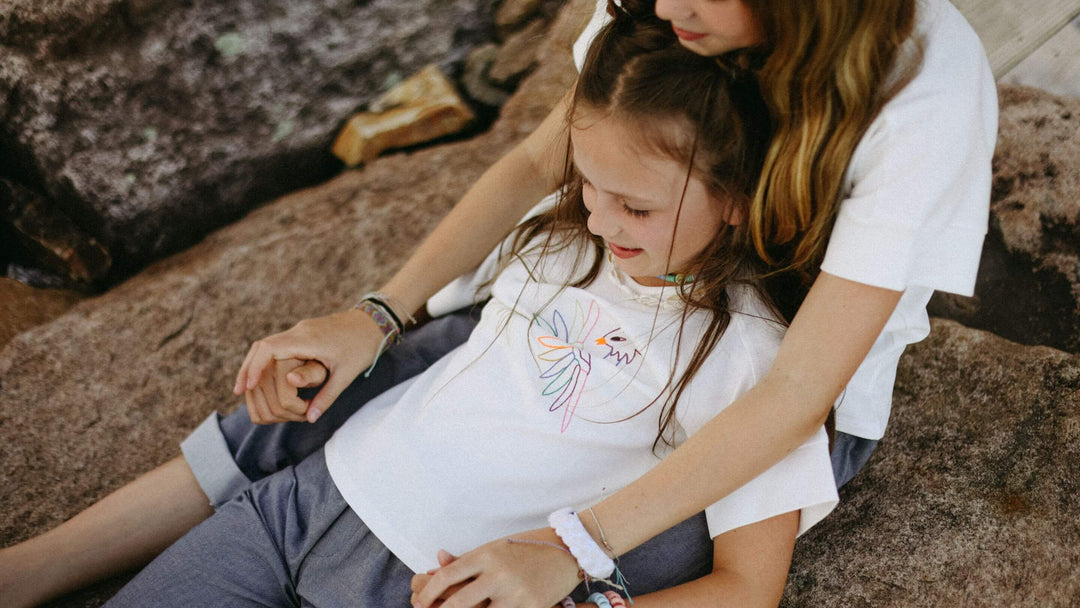
The same logic runs through the rest of a wardrobe. Our organic cotton graphic tees skip the “easy-care” synthetic route, and our organic cotton sweatpants stand in for the athleisure bottoms that often carry finishes.
For a fuller comparison of how each fiber performs, we went deep on which fabrics are healthiest for children’s clothing in a separate post.
How to Evaluate a Brand’s Claims
Certifications and labels get you most of the way. The last step is reading the brand itself. Start by asking which certifications a brand actually holds, who tested the garment, and whether the claims cover trims and dyes or only the main fabric. Specific answers are a good sign. Silence or a subject change is an answer too.
From there, the signals sort into two piles:
-
Red flags cluster together: Vague "non-toxic" wording with no named standard, no third-party verification, and "eco" language that stays abstract are the usual greenwashing pattern. So is a claim that quietly covers only part of the garment.
-
Green flags are just as legible: Named standards, published testing, and openness about where and how clothes are made.
As a working example, we publish our materials and our no-treatment policy so a parent can check the claim rather than take it on faith. That's the bar transparency should clear, whatever brand you're evaluating.
Caring for Non-Toxic Clothes So They Last
The point of buying better is wearing it longer, which is also how the higher upfront price earns out. A few habits protect both the fabric and the value.
Wash new garments before first wear to clear residual finishing chemistry and any free formaldehyde on the surface. Then wash and dry on low temperatures, which is gentler on untreated natural fibers than high heat.
Because untreated cotton shrinks, size up a little at purchase and you’ll get the full run of wear out of a piece. When your kid outgrows it, a well-made garment still has life in it. Passing it down between siblings or reselling it spreads the cost across more than one childhood, which is the math that makes buying clean worth it.
Reading Labels Beats Trusting Them
Non-toxic isn’t a badge you can take at face value, because no one polices the word. It’s a set of specifics you can check: which chemicals a garment leaves out, what the fiber content and care language admit to, which named certifications back the claim, and how openly a brand answers when you ask.
A parent who reads the tag and asks those questions doesn’t need the marketing to be honest. You can see for yourself.
And the payoff runs past safety into durability and cost-per-wear, because the garments made without shortcut chemistry are usually the ones built to last through washes, siblings, and a resale listing after that.